Tuesday, May 31, 2011

BLOG #7

Compare and contrast two biomes describe them in detail include pictures of plants and animals you are liklely to see.


DESERT BIOME: 
Deserts cover about one fifth of the Earth's surface and occur where rainfall is less than 50 cm/year. Although most deserts, such as the Sahara of North Africa and the deserts of the southwestern U.S., Mexico, and Australia, occur at low latitudes, another kind of desert, cold deserts, occur in the basin and range area of Utah and Nevada and in parts of western Asia. Most deserts have a considerable amount of specialized vegetation, as well as specialized vertebrate and invertebrate animals. Soils often have abundant nutrients because they need only water to become very productive and have little or no organic matter. Disturbances are common in the form of occasional fires or cold weather, and sudden, infrequent, but intense rains that cause flooding.

There are relatively few large mammals in deserts because most are not capable of storing sufficient water and withstanding the heat. Deserts often provide little shelter from the sun for large animals. The dominant animals of warm deserts are nonmammalian vertebrates, such as reptiles. Mammals are usually small, like the kangaroo mice of North American deserts.
Desert biomes can be classified according to several characteristics. The 4 major types of deserts are : HOT & DRY, SEMIARID, COASTAL, & COLD.

  • TUNDRA BIOME: 
Tundra is the coldest of all the biomes. Tundra comes from the Finnish word tunturi, meaning treeless plain. It is noted for its frost-molded landscapes, extremely low temperatures, little precipitation, poor nutrients, and short growing seasons. Dead organic material functions as a nutrient pool. The two major nutrients are nitrogen and phosphorus. Nitrogen is created by biological fixation, and phosphorus is created by precipitation.
 CHARACTERISTICS

  1. Extremely cold climate
  2. Low biotic diversity
  3. Simple vegetation structure
  4. Limitation of drainage
  5. Short season of growth and reproduction
  6. Energy and nutrients in the form of dead organic material
  7. Large population oscillations

Monday, May 30, 2011

BLOG #6

Which level of a food pyramid is the most important?


I believe that the most important level in the food pyramid is GRAINS . Even though its at the very bottom of the pyramid , doesn't mean its the worst . Its just that not most people eat grains for health & carbohydrates. Its always best to eat whole wheat grains, because it reduces the rate of getting heart disease & its full of fiber. & gives you energy. I believe its more important than fruits & vegetables but not many of people in the communities eat grains most of the time. Its good in a healthy diet & is prevents you from being constipated. & if you pregnant, eating grains will give you a healthy and wonderful baby. the nutrients in grains are: fiber, minerals, & vitamin B. & is healthy for the cholesterol .

BLOG #5

There have been 5 major extinction events throughout history, are humans impacting the 6th? Why or why not?


There were 5 major extinction events throughout history. They are the end-Ordovician extinction, end-Devonian extinction, end-Permian extinction, the Triassic extinction, end-Cretaceous extinction . I NEGATIVELY believe that humans are impacting the 6th extinction , because there are so many people in this world that would risk it all just to save the lives of many animals . I believe that they are helping them not cause the next extinction . But for the people that use animals for product examples is CRUEL , because they dont know the feeling that the animal is feeling , so why should the animals do it . So, in conclusion- i dont think the humans are impacting on the 6th extinction.


BLOG #4

 Describe the three types of selection: directional, stabilizing and disruptive and give an example of each in your own words


the 3 types of selection are : directional, stabilizing , & disruptive. An example of directional selection can be found in the breeding of a greyhound dog . they have a comparisons of dogs that run the fastest. An example of stabilizing selection is sexual dimorphism & the size of newborn human babies. An example of disruptive selection is the genotype & phenotype of rabbits - to calculate which ones have white & black fur or both , its in the genes & it matters on the biodiversity of growth over time .


BLOG #3

Explain what microevolution is? What are the three ways that variation occurs?


Microevolution is the change in allele frequencies brought about by mutation, genetic drift, gene flow, and natural selection below the species level. Over time, microevolution can translate into macroevolution, which is larger scale change above the species level.
selective breeding , mutation , & crossing over are the 3 ways variation occurs , but the main clue is that variation & microevolution arent the same .
this picture shows variation.

Thursday, February 24, 2011

BLOG # 2

  Why is fossil record hard to interpret?
our scientific community has changed & evolved throughout the years. Darwin's theory of evolution says that life evolves gradually, by imperceptibly tiny steps. Darwin says life is a continuous chain -- from the simplest one-celled organism to the most complex birds and beast animals. There are clear gaps between major biological categories, with no blurring of the boundaries. The history of paleontology is a large history that has missing links , so millions of fossil records are missing. now a days', the fossil records have changed & are more different now from back then .

Thursday, February 3, 2011

EVOLUTION' . BLOG 1

Evolution is defined as a theory and not a law, because in evolution... a lot of change happens and you can discover something new in the change . In evolution, organisms inherit traits, and they can develop something new- so its more of a theory than a law. Charles Darwin wrote about origin of species- in relation to evolution. Different changes happen over time. For example, the human evolution .


Thursday, January 13, 2011

LAST BLOG OF THE SEMESTER

Class of biology, taught by ms. malonek . is a good class but i would like to change one thing .
i would like to change all the notebook work . its simple & i can do it . but theres too much to do . i dont have time for other homeworks to finish . Also... we need to go on field trips that relate to BIO so we can experience and learn . & we should do experiments that we can think of .

Thursday, December 16, 2010

blog 9 KIM CHI


  • INGREDIENTS :
  • 3 tablespoons plus 1 teaspoon sea salt
  • 6 cups water
  • 2 lbs. Chinese (Napa) cabbage, cut into 2-inch squares
  • 6 scallions, cut into 2-inch lengths, then slivered
  • 1 1/2 tablespoons minced fresh ginger
  • 1 cup of minced garlic
  • 3 tablespoons of brine shrimp sauce or anchovy fish sauce(available Korean specialty stores)
  • 1/4 cup of Korean ground dried hot pepper (or other mildly hot ground red pepper)
  • 1 cup of shredded Korean radish (moo in Korean)
  • 1 teaspoon sugar

Thursday, December 9, 2010

Blog 11 GATTACA

In the movie Gattaca, parents were allowed to pick the traits of their babies, should we be able to do this? Why or why not?
I think that they shouldn't pick the traits of their babies, because it depends on how the baby comes out. They cant just pick it like a robot kid, we shouldn't be able to do this... because you wouldnt know how your baby would look like yet in the stomach.
it would be very lucky though, if the parents got to pick the traits of their babies...


gattaca new copy.preview.jpg

Thursday, October 7, 2010

Bacteria(s): For the GOOD and BAD...


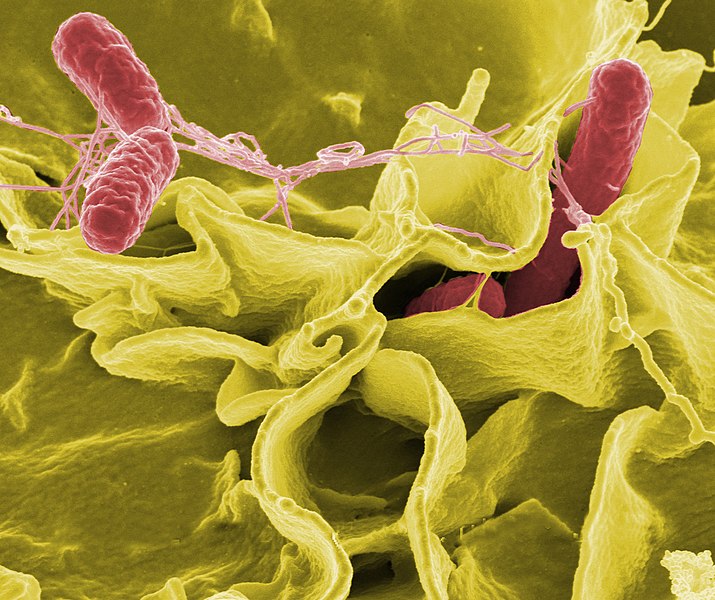
File:SalmonellaNIAID.jpg

Harmful bacterias are called pathogenic bacteria and can cause bacterial infection and diseases. They are single-celled little micro-organisms and can reproduce fast, so the germs can spread easily. An example of a bad bacteria is Salmonella. It is a type of food poisoning. Also it can cause illness.


There are different types of bacterias all around us. Bacterias like: lactobacillus is used as good bacteria, because it is used to preserve milk and plant products. The basic research says that the intestine's bacteria is SO numerous, that they make up 95% of the total cells in the human body. They help prevent bad bacteria from going near you and harming you. Lactobacillus is a bacteria that prevents you from having diseases. So the harmless bacteria are called non-pathogenic bacteria.

http://www.about-salmonella.com/http://www.drmirkin.com/nutrition/8966.html
http://www.buzzle.com/articles/helpful-and-harmful-types-of-bacteria.html
http://www.associatedcontent.com/article/51175/understanding_bacteria_harmless_and.html

Thursday, September 30, 2010

Metric System... Yes or No?

Honestly, i dont think that the US should switch tot he metric system. Changing the systems will make it more difficult and more confusing. Also, it would've been useless and confusing to everyone. Measurements we use now are inches, feet, meters, millimeters, decimeters, and etc. We should just stick to this measurement and not cause anymore difficulties.

Thursday, September 23, 2010

Biology Blog.


I dont believe that non carbon based life forms are possible to be alive, because everything in this world is full of carbon. We breathe in oxygen and we breathe out carbon dioxide. Also, plants take in carbon dioxide. Carbon is all over the place. Every living thing needs carbon to be alive.

Thursday, September 9, 2010

My Goals

My goals for Biology class are to always take notes so I can keep track, always pay attention, be on task, never to slack off, try my hardest to get straight A's. I want this class to be fun. & I also want to be successful in this class so in the future i can reach my goal all the way to the top.